AUSTRALIA BELOW THE SURFACE
Every wreck has a story.
Historic ships, former naval vessels and scattered remains. Explore Australia’s wreck-diving places—and learn how to read the story behind the steel.
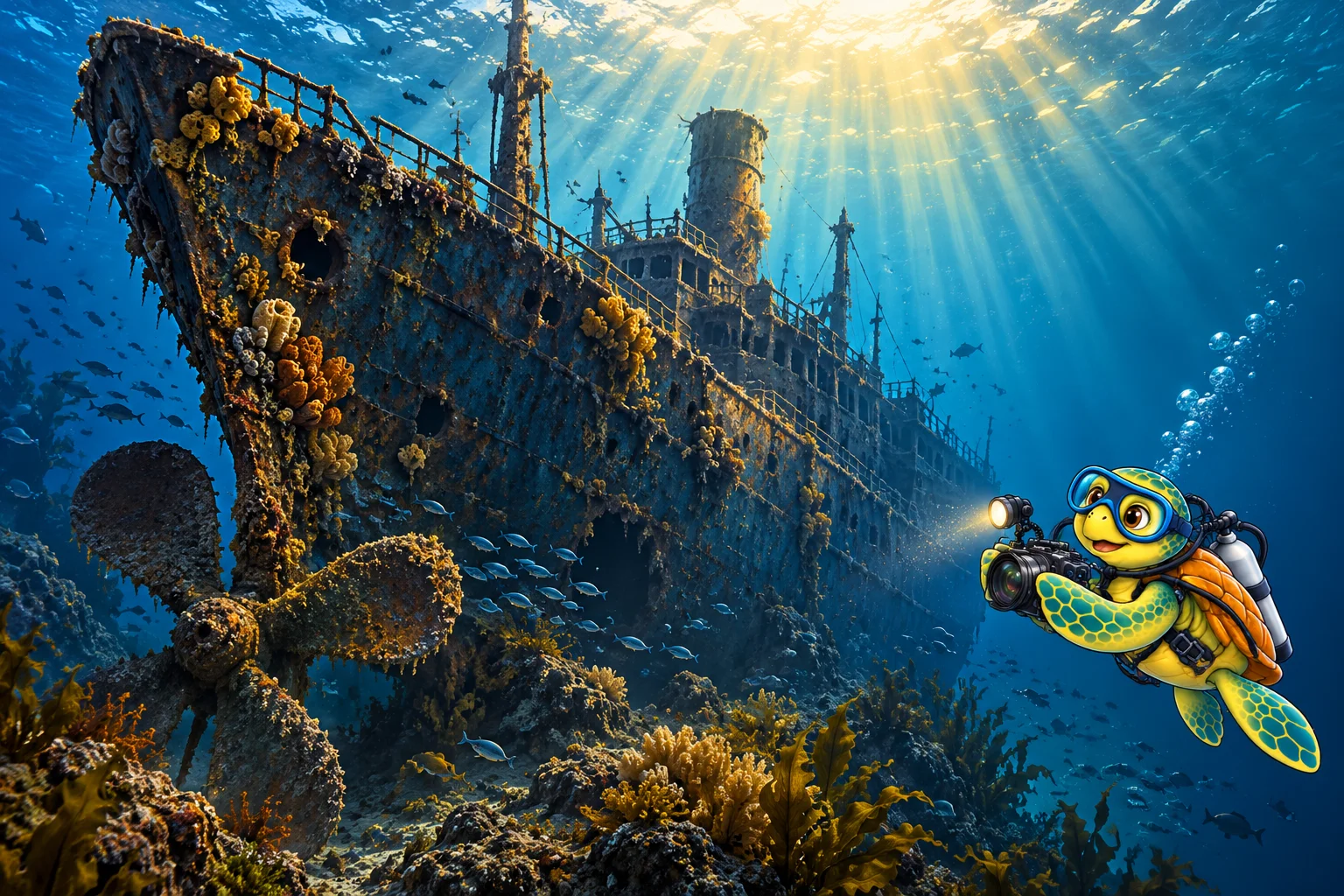
AI illustration of a fictional wreck. Not a photograph, site plan or equipment demonstration.
HISTORY. HABITAT. EXPLORATION.
Find the wreck.
Understand the dive.
A wreck’s name and depth are only the beginning. Its history, condition, access rules and the route you intend to dive all matter. Use this section to discover places, compare records and ask better questions of local operators.
Our directory includes wreck remains and reef sites associated with wrecks. Inclusion does not mean a site is currently open, regularly visited or suitable for every diver.
10 CHAPTERS • ORIGINAL EXPLANATIONS
Start with the learning guide
Understand the wreck you are looking at
Distinguish a vessel’s history from the kind of dive it offers.
Read depth, access and location correctly
Turn a directory entry into questions that can be verified.
Choose a first wreck for the experience you have
Compare the proposed trip, not a list of famous names.
Know the boundary between outside and inside
Recognise when the environment changes the training question.
Account for conditions and a changing structure
Read current notices before relying on old descriptions.
Connect training and equipment to the intended dive
Ask what a course teaches before choosing equipment or a certification.
Treat wrecks as heritage, not souvenirs
Find the applicable site rules and leave the evidence in place.
Photograph the wreck without changing the dive
Build a visual story from the route you have already agreed.
Build a booking that can survive a change of plan
Resolve practical questions before committing travel time and money.
Turn the dive into a better understanding of the wreck
Record observations that can improve your next visit and the directory.
A FEW STARTING POINTS
Wrecks to research
Explore these records for history, maps and local context. Recorded depths and operator links need confirmation for your actual trip; this is not a ranking or a list of guaranteed departures.
 Wreck
WreckSunshine Coast
Ex-HMAS Brisbane
Queensland's great destroyer wreck – 133 m, upright, funnels 3 m below the surface and 1000+ species – now with a…
WreckFleurieu Peninsula & Victor Harbor
Ex-HMAS Hobart
A 133 m guided missile destroyer sitting upright in 30 m with the superstructure from 5 m, and the only prepared naval wreck in…
WreckGeographe Bay & Busselton
HMAS Swan Wreck
A 113 m warship upright in 31 m with the crow's nest at 8 m and cut-outs for safe penetration - Australia's first purpose-sunk…
WreckTownsville & Magnetic Island
SS Yongala
A 109 m passenger steamer lost with all 122 aboard in the 1911 cyclone, lying almost intact on its side and swarmed by giant…
Artificial ReefPort Phillip Heads
ex-HMAS Canberra
A 138 m guided-missile frigate scuttled in 2009 and sitting almost upright in 28–32 m with the bridge at 8 m – bridge, galley,…
WreckHervey Bay & K'gari
ex-HMAS Tobruk
Australia's largest military dive wreck – a 127 m landing ship lying on her side, with the shallowest point at 11 m for Open…
BROWSE BY STATE & NAME
Explore the wreck directory
53 wreck-related recordsRecorded information, not live availability
WreckTasmania North & North-West
The Seal (Don Heads wreck)
A deep, rarely visited wreck off Don Heads, home to resident cod.
Details need confirmationArtificial ReefTasmania East Coast
Troy D
Tasmania's east-coast scuttled wreck: a 1000-tonne coastal trader sunk in 2007, with accessible bridge and engine room.
WreckHobart & Derwent
Tug Boyer (Betsey Island)
Intact hull of the Derwent's last working steam tug, beside the Macquarie.
Details need confirmationWreckTasman Peninsula
William Pitt Wreck (Canoe Bay)
Shallow scuttled 1904 dredge breaking the surface in a sheltered bay – a classic snorkel wreck.
Shore/Rock PlatformTasmania East Coast
Wineglass Bay Whaling Station
A secluded snorkel in Tasmania's most famous bay, with the remains of the Wenona (1981) and a kelp garden.
Details need confirmationGo deeper into the history
Use heritage records to investigate a vessel’s identity and story, then check site managers and operators separately for present-day access.
DCCEEW — Underwater cultural heritage
Australian underwater heritage framework and research resources.
Open primary source ↗WA Museum — Maritime Archaeology Databases
Researching ship identities, archaeological records and artefacts.
Open primary source ↗DCCEEW — Underwater heritage protected zones
Site-specific protected zones and activities requiring permission.
Open primary source ↗