AUSTRALIA BELOW THE SURFACE
Every wreck has a story.
Historic ships, former naval vessels and scattered remains. Explore Australia’s wreck-diving places—and learn how to read the story behind the steel.
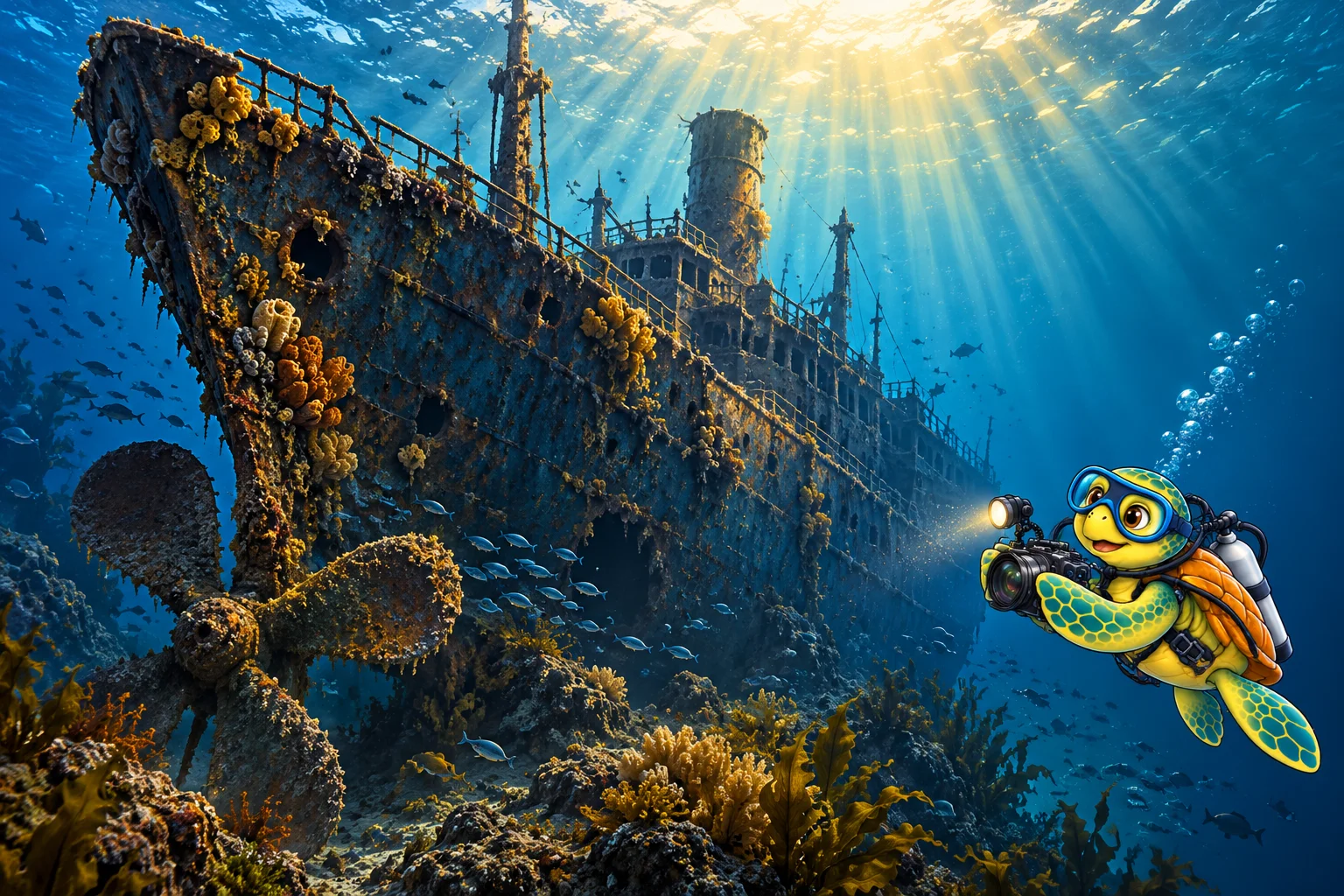
AI illustration of a fictional wreck. Not a photograph, site plan or equipment demonstration.
HISTORY. HABITAT. EXPLORATION.
Find the wreck.
Understand the dive.
A wreck’s name and depth are only the beginning. Its history, condition, access rules and the route you intend to dive all matter. Use this section to discover places, compare records and ask better questions of local operators.
Our directory includes wreck remains and reef sites associated with wrecks. Inclusion does not mean a site is currently open, regularly visited or suitable for every diver.
10 CHAPTERS • ORIGINAL EXPLANATIONS
Start with the learning guide
Understand the wreck you are looking at
Distinguish a vessel’s history from the kind of dive it offers.
Read depth, access and location correctly
Turn a directory entry into questions that can be verified.
Choose a first wreck for the experience you have
Compare the proposed trip, not a list of famous names.
Know the boundary between outside and inside
Recognise when the environment changes the training question.
Account for conditions and a changing structure
Read current notices before relying on old descriptions.
Connect training and equipment to the intended dive
Ask what a course teaches before choosing equipment or a certification.
Treat wrecks as heritage, not souvenirs
Find the applicable site rules and leave the evidence in place.
Photograph the wreck without changing the dive
Build a visual story from the route you have already agreed.
Build a booking that can survive a change of plan
Resolve practical questions before committing travel time and money.
Turn the dive into a better understanding of the wreck
Record observations that can improve your next visit and the directory.
A FEW STARTING POINTS
Wrecks to research
Explore these records for history, maps and local context. Recorded depths and operator links need confirmation for your actual trip; this is not a ranking or a list of guaranteed departures.
 Wreck
WreckSunshine Coast
Ex-HMAS Brisbane
Queensland's great destroyer wreck – 133 m, upright, funnels 3 m below the surface and 1000+ species – now with a…
WreckFleurieu Peninsula & Victor Harbor
Ex-HMAS Hobart
A 133 m guided missile destroyer sitting upright in 30 m with the superstructure from 5 m, and the only prepared naval wreck in…
WreckGeographe Bay & Busselton
HMAS Swan Wreck
A 113 m warship upright in 31 m with the crow's nest at 8 m and cut-outs for safe penetration - Australia's first purpose-sunk…
WreckTownsville & Magnetic Island
SS Yongala
A 109 m passenger steamer lost with all 122 aboard in the 1911 cyclone, lying almost intact on its side and swarmed by giant…
Artificial ReefPort Phillip Heads
ex-HMAS Canberra
A 138 m guided-missile frigate scuttled in 2009 and sitting almost upright in 28–32 m with the bridge at 8 m – bridge, galley,…
WreckHervey Bay & K'gari
ex-HMAS Tobruk
Australia's largest military dive wreck – a 127 m landing ship lying on her side, with the shallowest point at 11 m for Open…
BROWSE BY STATE & NAME
Explore the wreck directory
112 wreck-related recordsRecorded information, not live availability
WreckSurf Coast & Great Ocean Road
Speculant
Iron ribs and plating of a 1911 barquentine in the surge gutters directly below the Great Ocean Road at Cape Patton – a heritage…
WreckPhillip Island & Western Port
Speke
The second-largest full-rigged ship ever built, wrecked in 1906 – her bow standing on the rocks at Watt Point and the eroded hull…
Jetty/PierGeelong & Bellarine
St Leonards Pier
The Bellarine's best pier: 4-6 m of sheltered, weedy water with seahorses, stargazers and cuttlefish, an 1850s wreck's ribs, and…
WreckPhillip Island & Western Port
TSS Coramba
A Western District coastal steamer lost with all 17 hands in a 1934 storm, found by Southern Ocean Exploration in 2011 lying…
WreckWilsons Promontory
TSS Kanowna
A 126 m WWI hospital ship and coastal liner lost in fog in 1929, found in 2005 and lying largely recognisable in 80–82 m of clear…
WreckShipwreck Coast & Warrnambool
Thistle, Port Fairy
Timbers of the Henty family's Indian-built brigantine, which carried the first settlers to Portland Bay in 1834, in the wading…
WreckPort Phillip Heads
VHB 53
The last vessel scuttled in the Ships' Graveyard (1971) – a Dutch hopper barge in 52–57 m with a penetrable stern and its great…
WreckPort Phillip Heads
VHB 54
One of the last two vessels scuttled in the Graveyard (1970) – a simple steel hopper barge with the big cogged door-wheel…
WreckSurf Coast & Great Ocean Road
Victoria Tower
An 1869 iron clipper lost in fog on her maiden voyage – intact bow with bowsprit, standing frames, hatches and fallen masts in…
WreckPort Phillip Heads
Victorian
An 1876 iron steamer and coal hulk dumped in the outer Heads ground in 1925 – position and condition unconfirmed; a sounder…
Details need confirmationWreckPort Phillip Heads
Wareatea
A 1883 Bass Strait passenger-cargo steamer with twin hatches and central superstructure under heavy sponge growth in 48 m; rarely…
WreckPort Phillip Heads
Werfa
An 1883 Welsh collier, sunk by a US destroyer in Victoria Dock in 1925 and scuttled in 1929 – swim-throughs and a fully intact…
WreckPort Phillip Heads
White Pine
An 1879 Aberdeen-built iron barque famous for fast passages, ending as a Harbour Trust coal hulk in 1947 – intact bow and…
WreckPort Phillip Heads
William Salthouse
Australia's first Canada–Australia trader, lost in 1841 with her cargo of barrels still in the hold – an intact early-colonial…
WreckPort Phillip Heads
Wills
One of the five Harbour Trust hopper barges scuttled together in 1935 – an 1884 Adelaide-built sister of the Burke, in about 55…
Details need confirmationArtificial ReefPort Phillip Heads
ex-HMAS Canberra
A 138 m guided-missile frigate scuttled in 2009 and sitting almost upright in 28–32 m with the bridge at 8 m – bridge, galley,…
Go deeper into the history
Use heritage records to investigate a vessel’s identity and story, then check site managers and operators separately for present-day access.
DCCEEW — Underwater cultural heritage
Australian underwater heritage framework and research resources.
Open primary source ↗WA Museum — Maritime Archaeology Databases
Researching ship identities, archaeological records and artefacts.
Open primary source ↗DCCEEW — Underwater heritage protected zones
Site-specific protected zones and activities requiring permission.
Open primary source ↗