
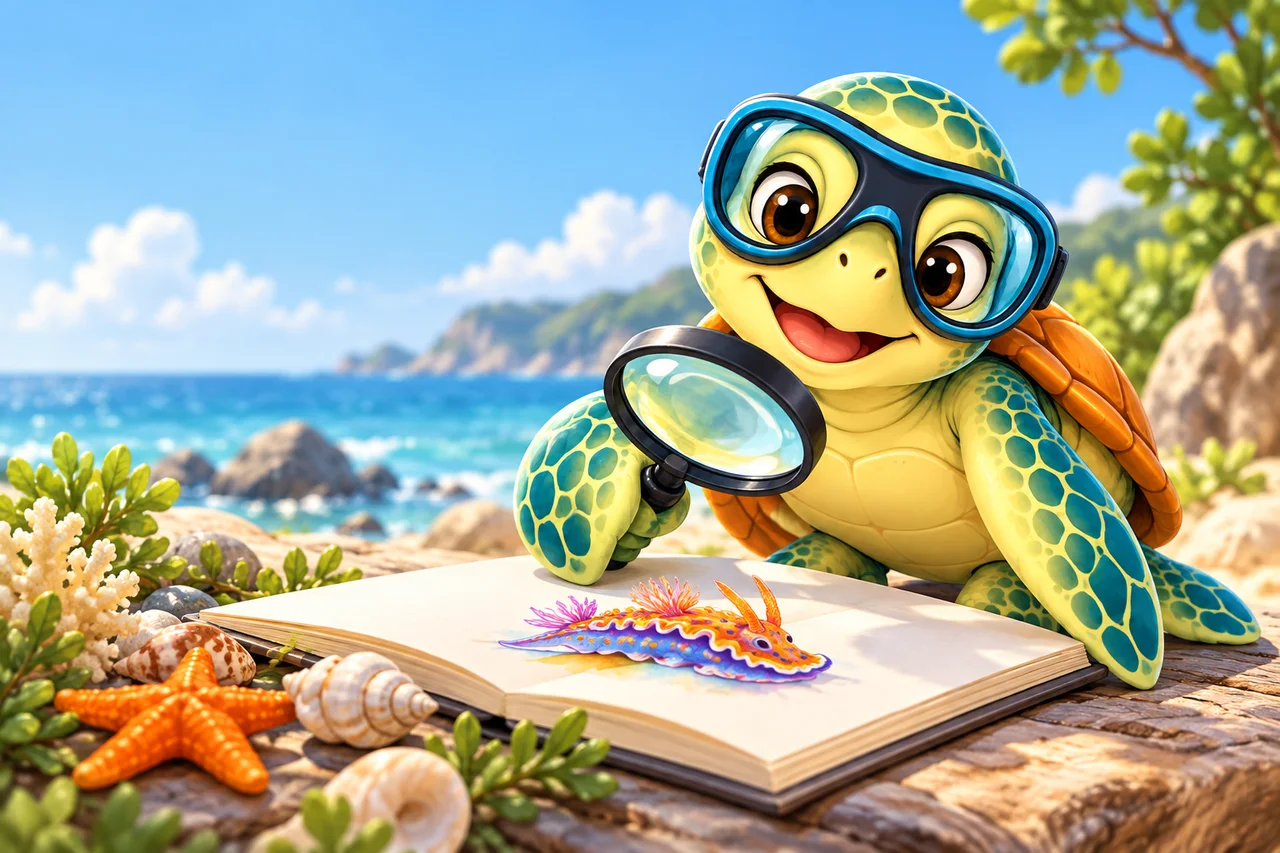
THE PRACTICAL ANSWER
Record marine-life encounters with clear identification confidence, habitat context and responsible location sharing rather than turning sightings into promises.
Your framework: Marine-life observation notes
Observation
Visible features and behaviour
- Useful even without a species name
Context
Date and broad habitat
- Preserves the setting of the encounter
Confidence
Confirmed, likely or unidentified
- Prevents a guess becoming a fact
Sharing
Project requirements and location sensitivity
- Avoids exposing sensitive information
Original YouDive planning framework. Organise the questions; confirm the answers with the appropriate provider.
Describe before you identify
Start with what you actually noticed: shape, approximate size, colour pattern, movement and surrounding habitat. Keep the description separate from the species name you think may apply. A careful observation can remain useful even when the identification is unresolved.
Photographs can help, but they do not automatically settle an identification. Lighting, angle and image processing can obscure features. Keep an original file where possible and write down the features you saw directly. Avoid editing an image in a way that creates a misleading identification feature.
Record context without disturbing the animal
After the dive, note the date, broad location and habitat context you remember. Keep measurements separate from estimates. If you did not record a temperature or depth for the observation, do not add one simply to make the entry look complete.
The quality of a record does not justify touching, chasing, repositioning or crowding wildlife. Follow the applicable site rules and guidance from your operator. If making a record would distract you from the dive plan or your buddy, leave the observation for another opportunity.
Use identification confidence openly
Choose a clear label such as confirmed by an appropriate identifier, likely identification or unidentified. Record who helped and which resource you used. If you later learn that an identification was wrong, update the record and retain enough context to understand the correction.
For citizen-science submissions, follow the receiving project’s requirements rather than assuming every platform wants the same fields. Some projects have specific geographic or photographic needs. Read their guidance on sensitive species and locations before sharing precise coordinates.
Share what one sighting can actually show
One observation records one encounter at a time and place. It does not demonstrate abundance, establish a migration pattern or guarantee that another diver will see the same animal. Write a caption that reflects that limit.
A small collection of accurate notes is more useful than a long species list assembled from uncertain guesses. Over time, compare your own observations cautiously and ask qualified identifiers about patterns. Keep the enjoyment of watching the animal at the centre of the activity rather than treating the dive as a checklist to complete.
| Consideration | What to record | Why it changes the decision |
|---|---|---|
| Observation | Visible features and behaviour | Useful even without a species name |
| Context | Date and broad habitat | Preserves the setting of the encounter |
| Confidence | Confirmed, likely or unidentified | Prevents a guess becoming a fact |
| Sharing | Project requirements and location sensitivity | Avoids exposing sensitive information |
A WORKED EXAMPLE · ILLUSTRATIVE SCENARIO
Correcting a species guess
A diver labels a photograph with a likely species name. Another observer later points out that the distinguishing feature is not visible. The diver changes the entry to a broader identification and retains the original location and habitat notes. The record becomes more reliable even though it sounds less specific. Correcting uncertainty is part of useful observation, not a failure to find something interesting.
Try it yourself
Make a sample observation with separate description, proposed identification, confidence and evidence fields. Do not force a species name.
Questions, answered
Can I identify a species from one photograph?
Sometimes, but some species require features a single photograph does not show. Keep uncertainty visible and consult an appropriate identification resource.
Should every sighting include exact coordinates?
No. Follow the project’s guidance and consider sensitive species and site access before publishing precise locations.
Does a sighting mean an animal is always at that site?
No. Present it as an observation, not a guarantee or a statement about abundance.
Reference desk
Original YouDive planning guidance. These official and specialist resources support further checking; they do not certify this article or a planned dive.
iNaturalist Australia — observations and identification ↗Reef Life Survey — marine biodiversity research ↗AI-assisted editorial content. Independent specialist review is pending. No first-hand product testing or site inspection is claimed.